Acts Alpha
This research is in alpha stage. We are actively collecting data, analyzing government Acts, and refining our understanding. Content may change significantly as our research progresses. Contributions and feedback are welcome.
Overview
Researching on the Acts of Sri Lanka. The objective of this exercise is to figure out what are the Acts related to the institutes like Departments in the Sri Lankan government. In parallel to that, understanding what an Act represents and its anatomy is an interesting area to research. An Act is a guideline on performing certain duties which basically become the standard protocol to its functionality. To see if an entity is functioning as expected, a deeper understanding into an Act is required.
Data
The data is available in the acts repository. But this data has been already archived and periodically updated by nuuuwan in here.
Sample Acts Research
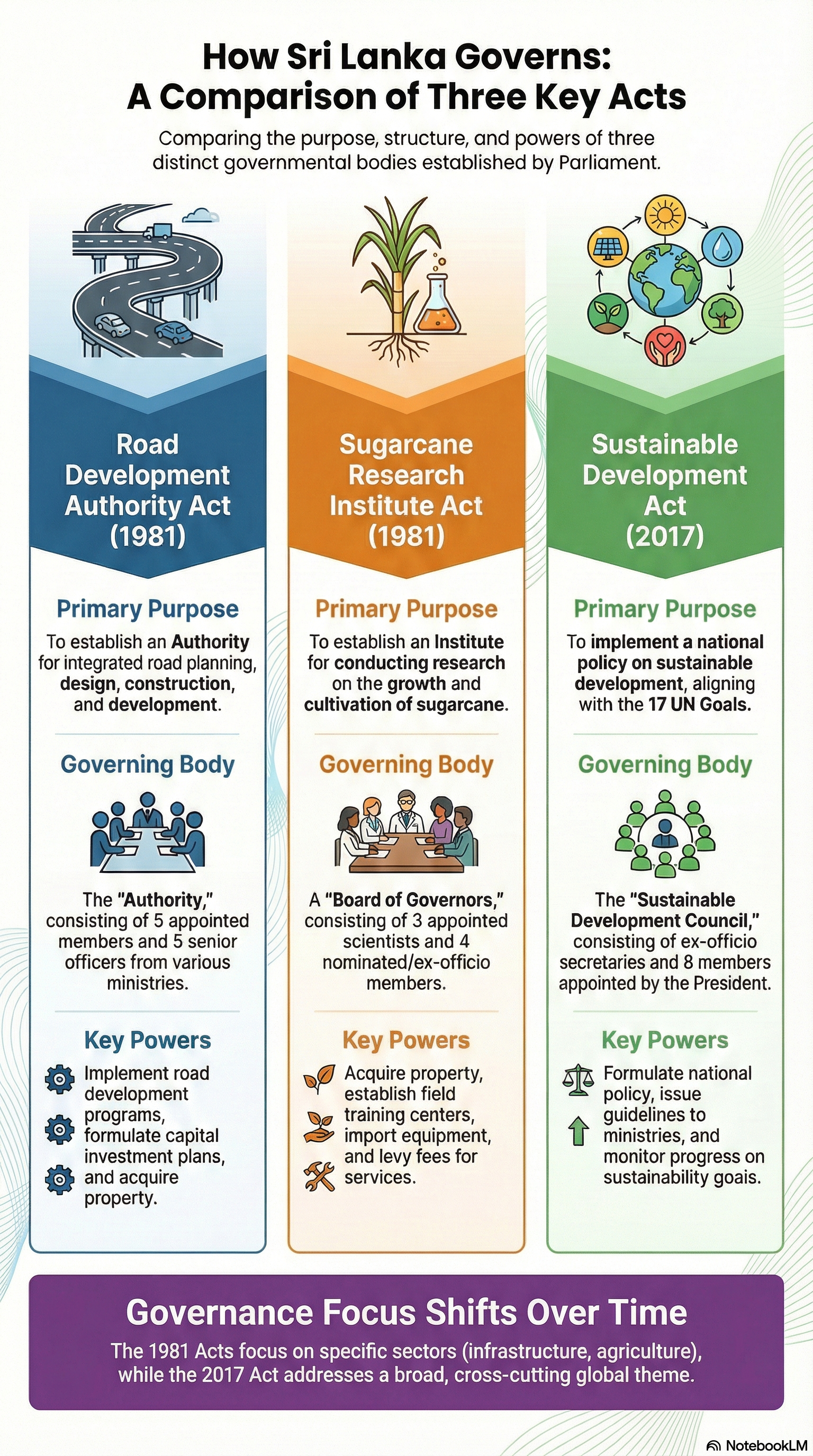
In this section we discuss the research conducted on a few sample acts. The evolution of governance and execution is detailed in the following document:
We used Notebook LM to dive deeper into an act.
How Notebook LM sees the Anatomy of an Act
Based on the three sources provided—the Road Development Authority Act (1981), the Sugarcane Research Institute Act (1981), and the Sri Lanka Sustainable Development Act (2017)—we can identify a distinct "anatomy" common to Acts establishing statutory bodies in Sri Lanka.
Here are the common attributes and structural components found across these Acts:
1. Preliminary Identifiers
Every Act begins with standard identifiers that establish its legal existence and scope.
- Number and Date: Each Act is assigned a number and a year (e.g., No. 73 of 1981) and includes a date of certification.
- Long Title: This appears at the very top and describes the general purpose of the Act. For example, the Road Development Authority Act begins: "An Act to provide for the establishment of the Road Development Authority...", while the Sustainable Development Act begins: "An Act to provide for the development and implementation of a National Policy...".
- Short Title: Section 1 of every Act standardizes how it should be cited in the future (e.g., "This Act may be cited as the Sugarcane Research Institute Act, No. 75 of 1981").
- Preamble (Optional): While not present in the 1981 Acts provided, the 2017 Act includes a "Preamble" (starting with "WHEREAS...") to provide context regarding national and international commitments before the enactment clause.
2. Establishment of Legal Personality
A crucial function of these Acts is to turn an organization into a legal entity separate from the individuals running it.
- Body Corporate Status: All three Acts declare that the institution (Authority, Institute, or Council) is a "body corporate" with "perpetual succession." This ensures the institution continues to exist regardless of changes in membership.
- Common Seal: They are all authorized to use a "common seal" for official documents.
- Legal Capacity: The Acts explicitly state the institution may "sue and be sued" in its own name.
3. Governance Structure (The Board/Council)
The Acts define who governs the institution and how they are selected.
- Composition: The governing bodies consist of a mix of Ex-officio members (government officials holding a specific post, like a Ministry Secretary) and Appointed members (experts appointed by the Minister or President).
- Terms of Office: Appointed members typically hold office for a specific period, most commonly three years, with eligibility for reappointment.
- Removal and Resignation: There are standard provisions allowing the appointing authority (Minister or President) to remove members without assigning a reason, and allowing members to resign via written letter.
- Disqualification: The Acts list reasons a person cannot serve, such as being a Member of Parliament, having financial interests in contracts, or insolvency.
4. Operational Procedures
The Acts dictate how the governing body must function to ensure validity.
- Meetings and Quorum: They specify how often meetings must be held, who presides (usually the Chairman), and the "quorum" (minimum number of members required to make decisions, often five or three members).
- Voting: Decisions are made by a majority vote of members present, with the presiding member holding a "casting vote" in the event of a tie.
- Validity of Acts: A common clause ensures that proceedings are not invalid simply because there was a vacancy in the membership at the time.
5. Powers, Duties, and Functions
A substantial portion of each Act is dedicated to defining what the institution is actually allowed to do.
- Specific Powers: These usually include acquiring and holding property, charging fees, entering contracts, and establishing branches or committees.
- Policy Implementation: The institutions are tasked with carrying out specific development plans, research, or national strategies relevant to their sector.
6. Staffing and Administration
The Acts separate the governing board (policy) from the day-to-day management (execution).
- Chief Executive Officer: Provision is made for a General Manager, Director, or Director-General. This person is the chief executive but often does not vote at board meetings.
- Public Servant Status: Employees and members of the Board are legally deemed "public servants" for the purposes of the Penal Code.
- Bribery Act Application: The institutions are deemed "scheduled institutions" under the Bribery Act, subjecting them to anti-corruption laws.
7. Financial Provisions
Each Act establishes the financial independence and accountability of the institution.
- The Fund: A specific "Fund" is established for the institution to receive parliamentary votes, loans, or donations.
- Audit: The auditing of accounts is strictly governed by the Constitution (specifically Article 154), ensuring state oversight.
- Borrowing Powers: The institutions are generally empowered to borrow money, often requiring Ministerial consent.
8. Ministerial Control and Oversight
While these bodies are independent, they remain under the ultimate control of the Government.
- Directions: The Minister (or Government) has the power to issue general or special directions to the institution, which the institution is duty-bound to follow.
- Regulations/Rules: The Minister is empowered to make regulations to give effect to the Act. These regulations usually require publication in the Gazette and subsequent approval by Parliament.
9. Legal Protection
- Immunity: The Acts protect the institution and its members from civil or criminal lawsuits for acts done in "good faith" while performing their duties.
Analogy
To visualize the anatomy of an Act, you can think of it like the Constitution of a Ship:
- The Identifiers (Title/Date) are the ship's name and registration.
- Establishment (Body Corporate) is the hull, making it a solid, independent vessel that floats on its own.
- The Objects/Functions are the destination and mission (where is it going and why?).
- The Board/Council is the Bridge Crew (Captain/Officers) who steer the ship.
- The CEO/Staff are the Engine Room Crew who make the ship actually move.
- The Fund is the fuel tank.
- Ministerial Directions are orders coming from the Admiral on land, which the ship must obey.
Artifacts Generated
Governance Evolution Execution to Equipoise
The comparative analysis of three acts is illustrated below: